What is Bitcoin?
Bitcoin is a digital money that runs on a public network of computers instead of a bank or government. Its rules are open source, its supply is capped at 21 million coins, and anyone can check every transaction since 2009. People use it to save, to send value across borders, and as a high-risk investment.
Bitcoin in one minute
Bitcoin was launched in January 2009 by a pseudonymous creator called Satoshi Nakamoto, a few months after the 2008 financial crisis. The idea was simple and radical: a form of money that two people could send to each other over the internet without trusting a bank, a payment company, or a government to keep the books.
Instead of one company keeping the ledger, thousands of independent computers around the world keep identical copies of it. Every ten minutes or so, a new block of transactions is added. Computers that follow the rules accept it; anything that breaks the rules is rejected automatically.
What makes bitcoin different from dollars
- Fixed supply. There will never be more than 21 million bitcoin. More than 20 million — about 96% — had been created by November 2026, and new issuance halves roughly every four years in an event called the halving.
- No one in charge. No company or country can print more, freeze the network, or change the rules alone. Changes need broad agreement from the people running the software.
- Anyone can verify it. The full history is public. That is where the phrase "don't trust, verify" comes from.
- You can hold it yourself. Whoever controls the private keys controls the coins, with no account to open and no permission needed. That freedom comes with responsibility; see wallets and seed phrases.
What bitcoin is used for
Most people today hold bitcoin as a long-term savings asset, often described as "digital gold." It is also used to send money across borders quickly, by people in countries with high inflation or capital controls, and, increasingly, by software and AI agents that need to make small automatic payments over the Lightning Network.
The risks, honestly
Bitcoin's price is extremely volatile. It has fallen by 77% to 93% in past bear markets, and by about 52% from its October 2025 high of roughly $126,000 to a low near $60,000 in February 2026. It produces no income, so its value depends on future demand. Scams are common, and lost keys mean lost money. That is why beginners are usually advised to start small, learn first, and never invest money they need. Read is bitcoin a good investment? for the evidence.
Bitcoin vs "crypto"
Bitcoin was the first cryptocurrency and remains the largest. Thousands of other coins ("altcoins") followed, and most have failed. Stablecoins such as USDC and USDT are digital dollars, not bitcoin. When people say "crypto," they often mean all of these together; this site focuses on bitcoin itself.
Common questions
Who controls bitcoin?
No single person or company. The rules are enforced by thousands of independent computers (nodes) that each check every transaction. Changes require broad agreement, which makes the rules very hard to alter.
Do I have to buy a whole bitcoin?
No. One bitcoin divides into 100 million units called satoshis, or sats, so you can buy any amount, even a few dollars' worth.
Is bitcoin legal?
Yes, in the United States and most countries. It is regulated as property for US tax purposes, and US spot bitcoin ETFs have traded since January 2024. Rules differ by country.
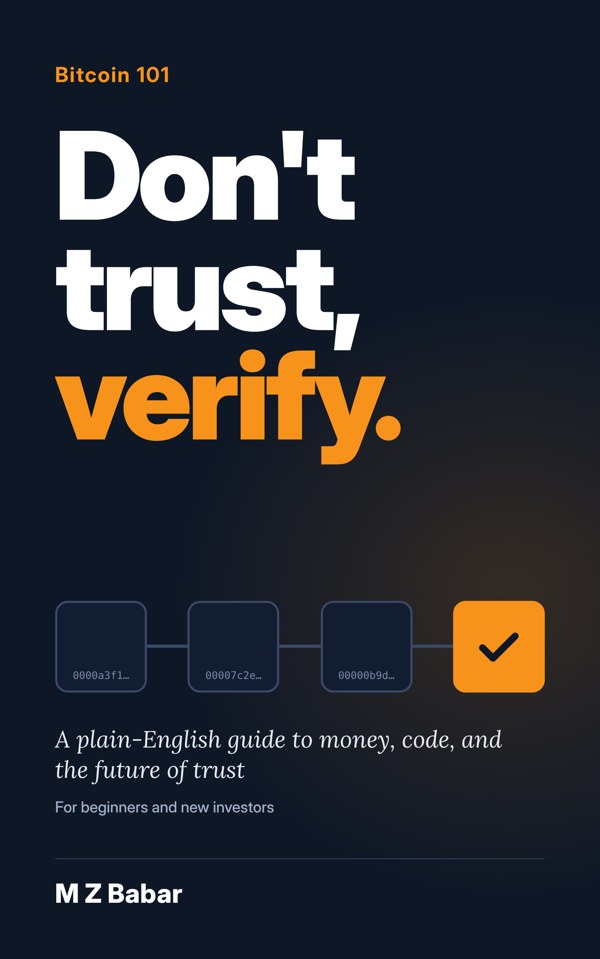
Go deeper: Don't Trust, Verify
A plain-English Bitcoin book for beginners and new investors: 27 chapters, 20 original charts, a written plan template and facts current to November 2026.
Get the bookRead chapter 1 free