Don't Trust, Verify
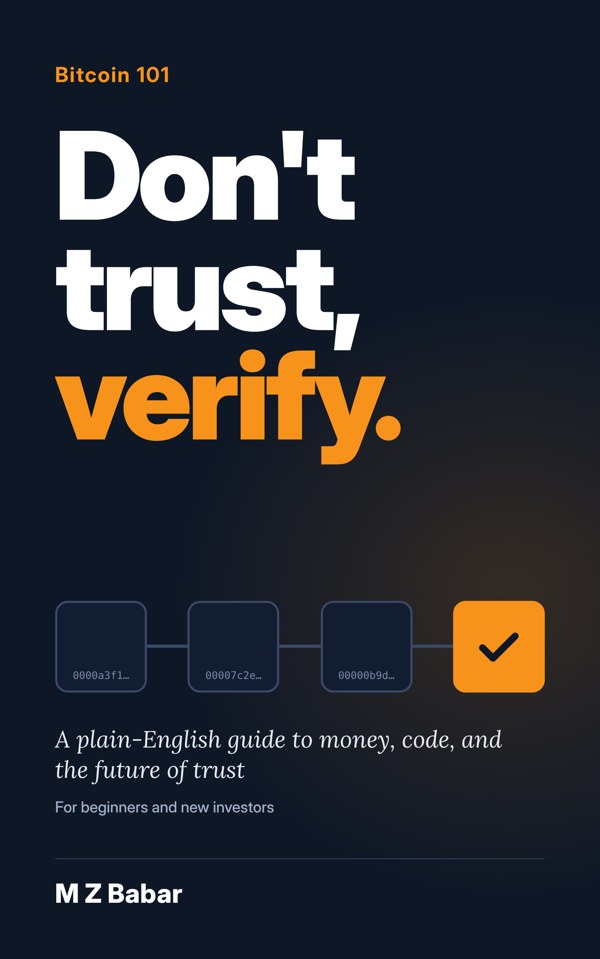
Cover of Don't Trust, Verify: Bitcoin 101 by M Z Babar

Don't trust, verify.

Bitcoin 101 — a plain-English guide to money, code, and the future of trust

For beginners and new investors, by M Z Babar

What bitcoin is, how it actually works, how to buy and keep it safely, and how to think about it as an investment — with the bull case and the bear case side by side. 27 chapters, 20 original charts and illustrations, a self-check quiz for every chapter, and facts current to November 2026.

Kindle and paperback

Or read the first chapter free

Instant PDF download after secure checkout with Stripe; Kindle and paperback on Amazon. Education only, not financial or tax advice. Read the disclaimer.

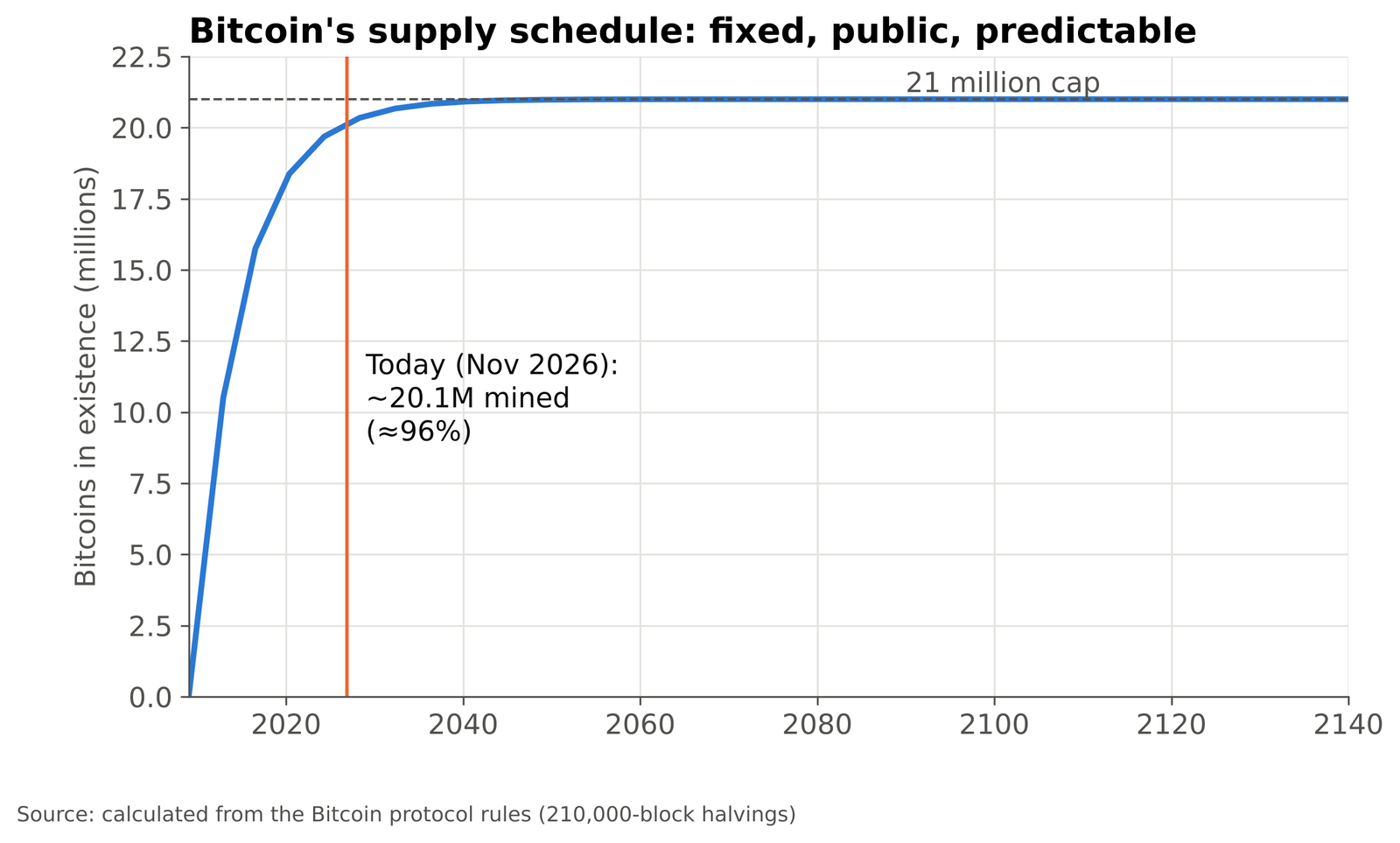
21 million bitcoins, ever. Here's how many exist today.

Each block below is one million bitcoins.

—bitcoins mined (estimate)
—of the 21 million cap
—current block height (estimate)
—until the next halving (~block 1,050,000)

Estimated from Bitcoin's issuance schedule (3.125 BTC per block since April 2024) and an average of one block every ten minutes, anchored to block 971,712 on 16 October 2026. Check a block explorer such as mempool.space for exact figures.

Bitcoin 101 in plain English

Short, honest answers to the questions beginners ask most, drawn from the book. Each one points to the chapter that goes deeper.

What is Bitcoin?

Bitcoin is a digital money that runs on a public network of computers instead of a bank or government. Its rules are open source, its supply is capped at 21 million coins, and anyone can check every transaction since 2009. People use it to save, to send value across borders, and as a high-risk investment.

More in Chapters 3–4.

How does Bitcoin work?

Every ten minutes or so, a new block of transactions is added to a shared record called the blockchain. Thousands of independent computers (nodes) keep identical copies and reject anything that breaks the rules. You prove ownership with a private key, which signs your transactions.

More in Chapters 4–8.

What is Bitcoin mining?

Miners compete to add the next block by running trillions of guesses to solve a puzzle — a method called proof of work. The winner earns newly created bitcoin plus fees. The energy cost makes rewriting history impractically expensive, which is what secures the ledger.

More in Chapter 6.

What is the Bitcoin halving?

Roughly every four years (every 210,000 blocks) the number of new bitcoins per block is cut in half. It fell to 3.125 BTC in April 2024, and the next halving is expected around April 2028. Halvings slow new supply until it ends near the year 2140.

More in Chapter 7.

Why are there only 21 million bitcoins?

The limit is written into the software that every node runs. Changing it would require almost every user to adopt new rules, which they have no reason to do. More than 20 million — about 96% — had already been mined by November 2026.

More in Chapter 7.

How do I buy bitcoin safely?

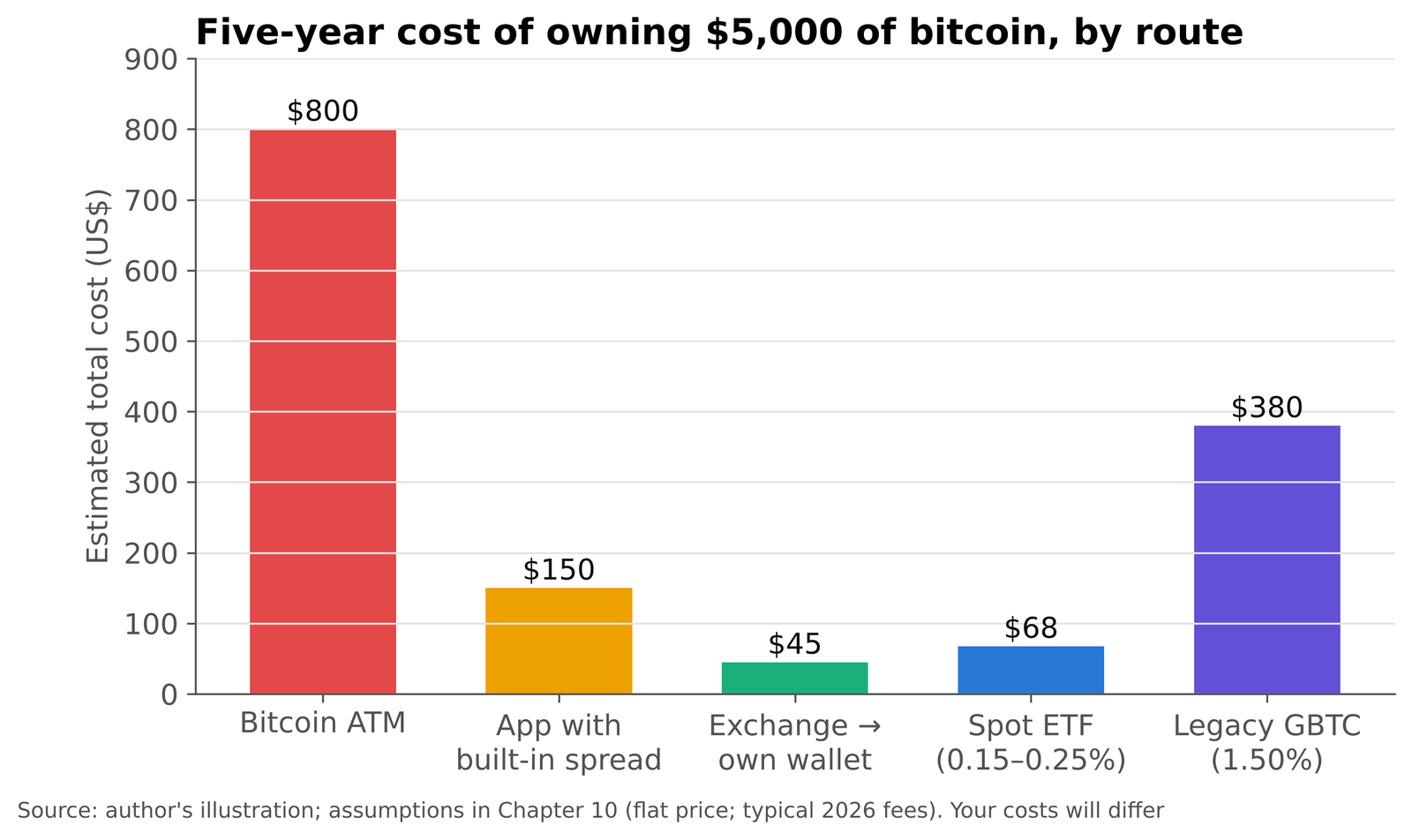
Most beginners use a regulated exchange or broker, or a spot bitcoin ETF in a brokerage account. Turn on app-based two-factor login, start small, check every address, and consider moving long-term savings to a wallet you control. Never buy because a stranger online told you to.

More in Chapter 10.

What is a bitcoin wallet and seed phrase?

A wallet stores the keys that control your bitcoin. Its seed phrase — 12 or 24 words — can restore those keys on any device. Whoever has the seed phrase has the bitcoin, so write it down offline and never share it.

More in Chapter 11.

Is bitcoin a good investment?

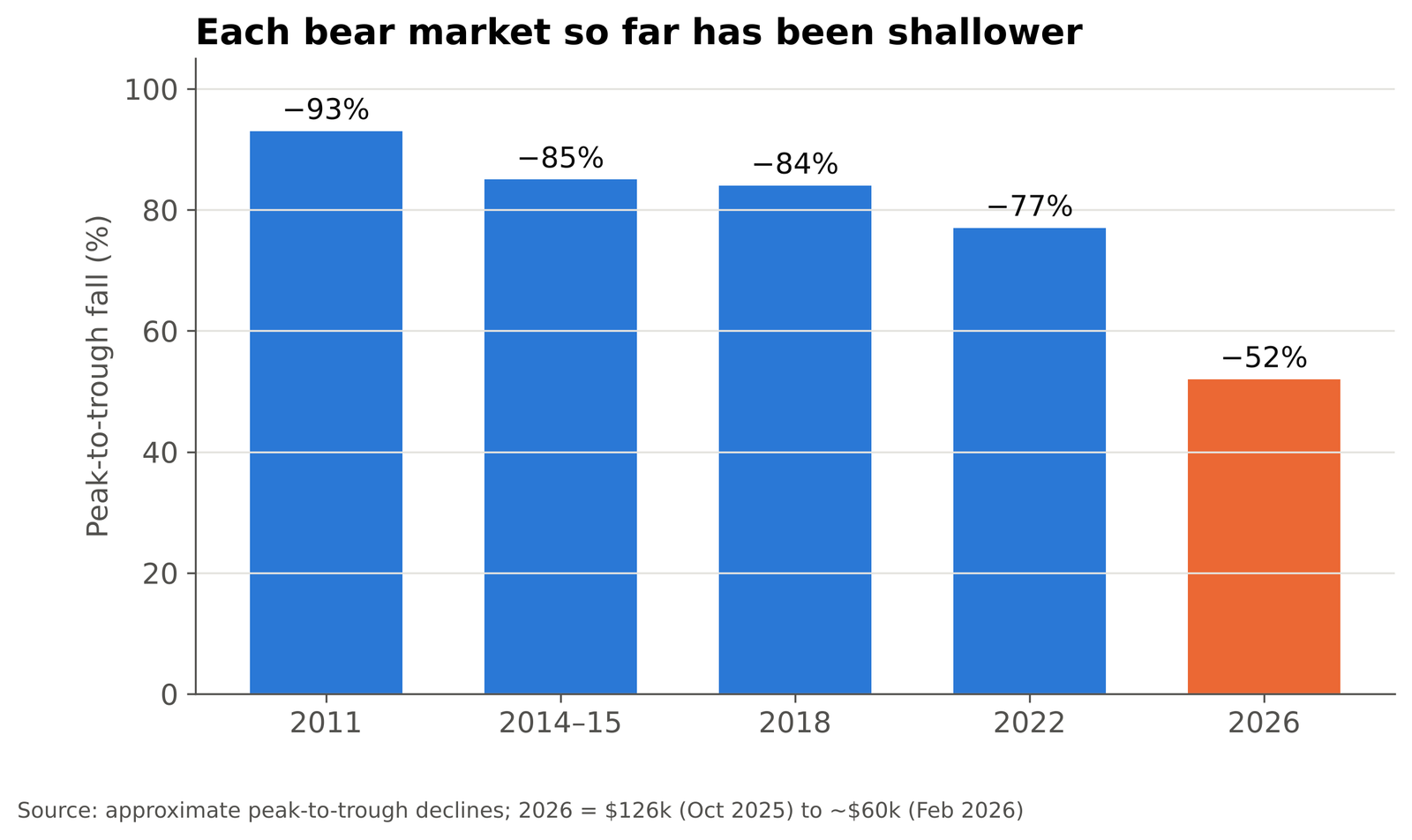
It has been one of the best-performing assets since 2010, and it has also fallen 77–93% in past bear markets. It produces no income, so its value depends on future demand. The book sets out the bull and bear cases side by side and shows how to size a position you could live with if it fell 80%.

More in Chapters 17–22.

Read the first chapter free

Get the Introduction and Chapter 1, "What Is Money?", as a PDF. Add your email to hear about launch-day pricing and the yearly updated edition.

Prefer not to sign up? Download the sample directly. You can also print the "My Bitcoin Plan" template from Appendix F.

Share your Bitcoin story

Your first purchase, a lesson learned the hard way, how bitcoin helped your family — real stories from readers may appear, with permission, in the next edition.

Story submissions open on launch day.

Inside the book

Five parts that take you from "what is money?" to the future of money in an age of AI. Read it front to back, or jump straight to Parts III and IV if you mainly want to invest.

Title
Don't Trust, Verify: Bitcoin 101 — A Plain-English Guide to Money, Code, and the Future of Trust
Author
M Z Babar
Editions
Kindle ebook and 6×9-inch paperback (about 280 pages)
Length
27 chapters, about 64,000 words, 20 original charts and illustrations
Facts current to
November 2026
Companion book
Beyond Fiat by M Z Babar

Part IMoney and its problems

  1. 1What Is Money?
  2. 2The Fiat Era: Inflation, Debt, and the 2008 Crisis
  3. 3The Birth of Bitcoin

Part IIHow Bitcoin works

  1. 4The Blockchain, Explained Simply
  2. 5Cryptography: Keys, Hashes, and Signatures
  3. 6Proof of Work and Mining
  4. 7Difficulty, Halvings, and the 21 Million Cap
  5. 8Nodes, Consensus, and How Bitcoin Changes
  6. 9Scaling Bitcoin: Lightning and Layers

Part IIIUsing Bitcoin

  1. 10Buying and Selling Bitcoin
  2. 11Wallets and Self-Custody
  3. 12Sending and Receiving Bitcoin
  4. 13Security: Hacks, Scams, and Staying Safe
  5. 14Privacy and Ownership
  6. 15Bitcoin Around the World
  7. 16Bitcoin for Families and Small Businesses

Part IVBitcoin as an investment

  1. 17The Digital Gold Thesis
  2. 18Price History and the Four-Year Cycle
  3. 19Whales, Institutions, and Retail Investors
  4. 20Beyond Bitcoin: Altcoins and Stablecoins
  5. 21Signal and Noise: Trustworthy Information
  6. 22Valuation, Projections, and Managing Risk
  7. 23Taxes, Regulation, and the Law

Part VThe future

  1. 24Machine Money: Bitcoin, AI, and Automation
  2. 25Threats and Open Questions
  3. 26The Future of Money and Trust
  4. 27Myths, Misconceptions, and Hard Questions

PlusTools to keep

  1. ·A 9-step action plan and a "first week with Bitcoin" exercise
  2. ·A full glossary and an 81-question self-check quiz
  3. ·Timeline from 1971 to the 2028 halving
  4. ·Four reader stories followed through the 2024–2026 cycle
  5. ·"My Bitcoin Plan" fill-in template and a full index
  6. ·Further reading and a full source list

Meet the four readers

The book follows four people through the 2024 halving, the 2025 record high and the 2026 crash. They're composites, not real people, but everything that happens to them has happened to real readers.

Sam Okafor

41, chemistry teacher, Ohio

Reads for three weekends before buying $100. Writes a one-page plan with his wife and sticks to it through the crash.

Chapters 10, 11, 22

Priya Raman

29, software engineer, Texas

Buys near the 2025 top with a fifth of her savings and a leveraged bet. Learns, without selling at the bottom, why size matters more than timing.

Chapters 18, 22

Walter Brooks

68, retired machinist, Pennsylvania

Stands at a bitcoin ATM with $18,000 in an envelope before his granddaughter calls. Chooses to own none, and now teaches others the warning signs.

Chapters 13, 22

Rosa Mendes

52, bakery owner, Florida

Sends dollars home to Venezuela in minutes, takes Lightning payments at her bakery, and learns how the IRS sees every one of them.

Chapters 12, 16, 23

A few of the book's charts

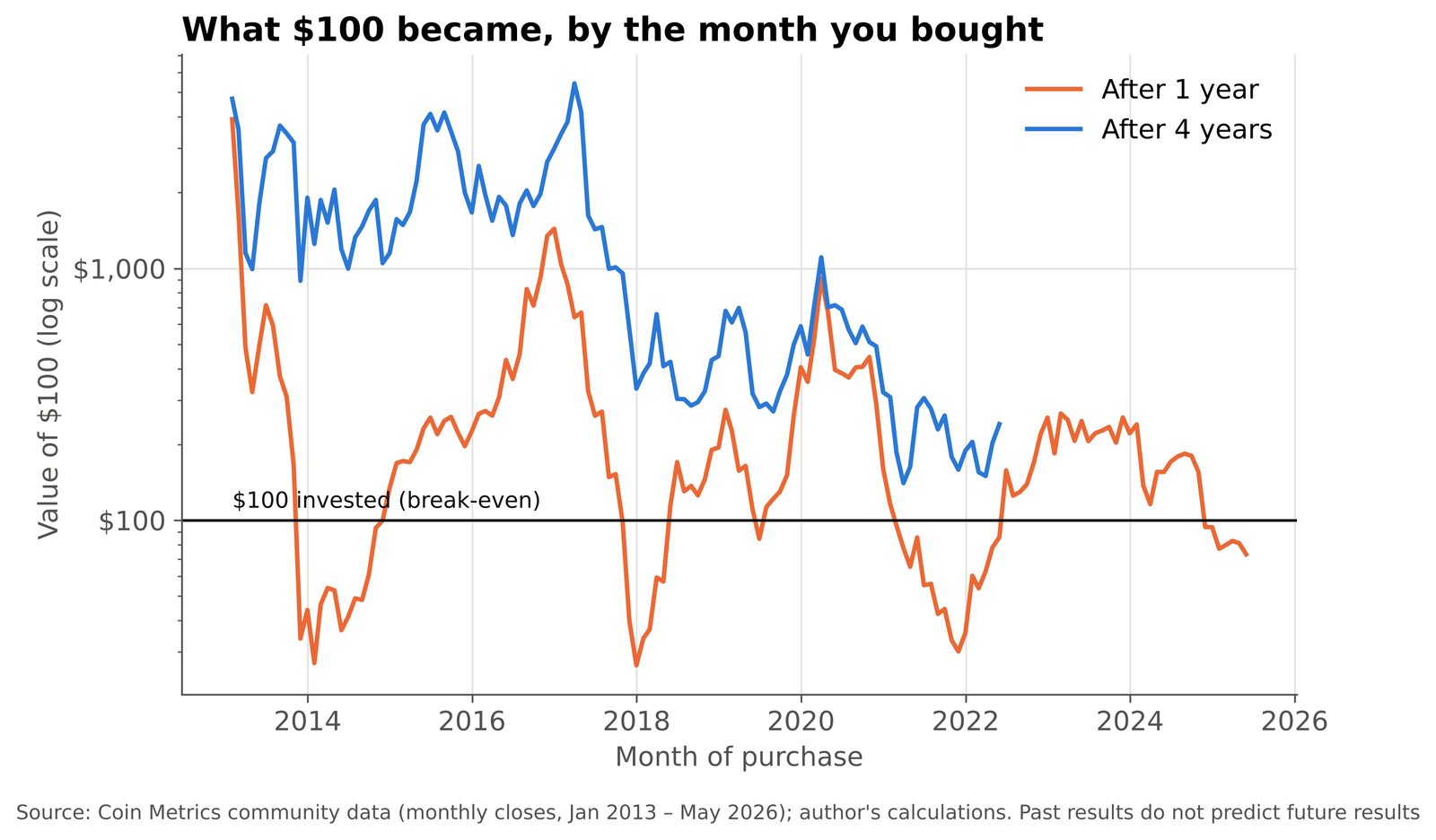
Every chart and diagram in the book was drawn for it from public data. Here are six of the twenty. Select any chart to open it full size.

Free calculators

Four small tools from ideas in the book. They run entirely in your browser and store nothing. Type in your own price — these are for learning, not trading.

Dollars to sats

One bitcoin is 100,000,000 satoshis ("sats"). You never need to buy a whole coin.

——

Dollar-cost averaging

Buy a fixed amount on a schedule. Enter an assumed average price to see roughly how much you'd accumulate.

——

Position size and the 80% stress test

Chapter 22's test, shared with Beyond Fiat: imagine bitcoin falls 80% the day after you buy. Could you live with the result?

——
—

Transaction fee estimate

Fees depend on a transaction's size in data, not on how much bitcoin you send (Chapter 12).

——

Your security checklist

The ten habits that prevent most losses, from Chapter 13. Tick them off as you go — your progress stays only in this browser.

0 of 10 done

Scam red flags

If you see one of these, stop and verify through a channel you already trust.

Someone you met online starts talking about investingThe classic opening of a romance or "pig-butchering" scam.
Guaranteed or unusually high returnsLegitimate investments never guarantee profits.
You must pay a "fee" or "tax" before withdrawingThe money is already gone. Do not send more.
Anyone asks for your seed phraseNo real company, wallet or support agent will ever ask. Ever.
"Police" or a "tax office" demands bitcoinGovernment agencies don't take payment through bitcoin ATMs.
"Send 0.1 BTC, get 0.2 back"Giveaway scams, often with AI-generated celebrity video.
"Support" messages you first on social mediaReal support teams don't cold-message you.
A service promises to recover stolen crypto for a feeThis is usually a second scam aimed at victims.

Key facts, November 2026

A snapshot of the numbers in the book, with sources. Markets move fast — treat these as a dated photograph and check current figures before acting.

WhatFigureSource
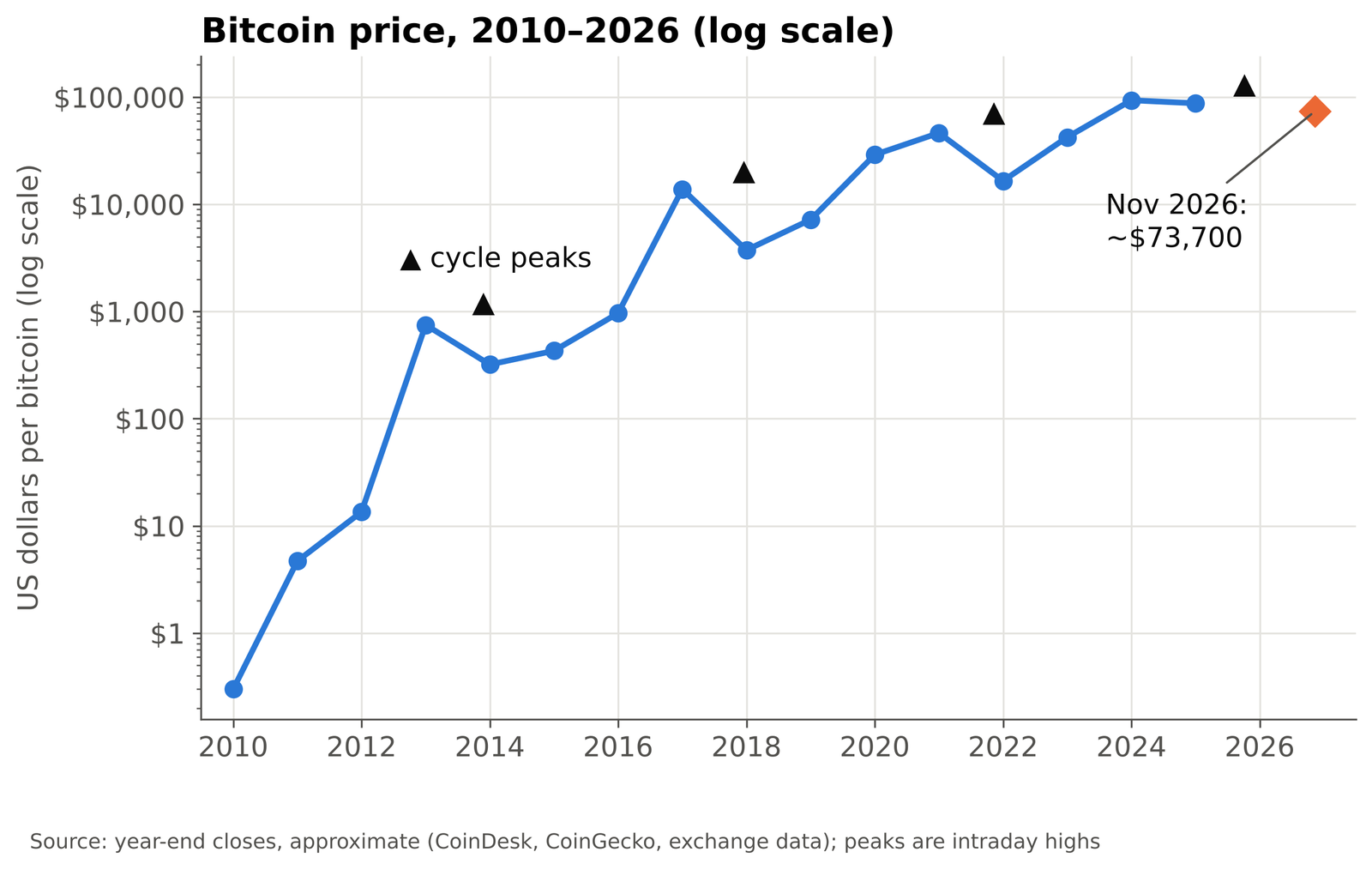
Bitcoin price≈ $73,500–74,000 (11 Nov 2026)CoinDesk
All-time high≈ $126,000 (6 Oct 2025)Coin Metrics
2026 low≈ $60,000 (5–6 Feb 2026)The Block
US spot bitcoin ETF assets≈ $102 billionSoSoValue (issuer data)
Strategy Inc holdings850,364 BTC (8 Nov 2026)SEC filings
Network hashrateAbove 1 zettahash/s (Oct 2026)mempool.space
Mining energy from sustainable sources52.4% (2025 survey)Cambridge
US Strategic Bitcoin ReserveCreated 6 Mar 2025; forfeited coins onlyThe Block
CLARITY Act (US market structure)Senate cloture failed 49–50 (15 Sep 2026)DLA Piper
EU MiCA transitionEnded 1 Jul 2026Elvinger Hoss
US broker tax reportingForm 1099-DA; cost basis for coins bought from 1 Jan 2026IRS
Bitcoin vs stocks and gold, end-2014 to May 2026≈ 62% a year with 72% volatility (stocks ≈ 12%/12%; gold ≈ 12.5%/12%)Coin Metrics; author's calculations
Four-year holding periods since 2011All profitable through May 2026; worst ≈ 9% a year (bought Mar 2021)Coin Metrics; author's calculations
Next halving≈ April 2028, block 1,050,000Bitcoin protocol rules

Glossary

The words you'll meet most often, in plain English. The book's glossary has the full list.

A short timeline

From the end of the gold standard to the next halving.

  1. The US ends the dollar's convertibility into gold. All major money becomes fiat.

  2. Satoshi Nakamoto publishes the Bitcoin white paper, six weeks after Lehman Brothers collapses.

  3. The genesis block is mined, carrying a headline about bank bailouts.

  4. 10,000 BTC buys two pizzas — the first real-world purchase.

  5. Mt. Gox collapses after losing about 850,000 BTC.

  6. SegWit activates after the block size war; Bitcoin Cash splits off.

  7. El Salvador makes bitcoin legal tender (scaled back in 2025).

  8. FTX collapses; bitcoin falls to about $15,500.

  1. US spot bitcoin ETFs begin trading.

  2. Fourth halving: 6.25 → 3.125 BTC per block.

  3. US Strategic Bitcoin Reserve created by executive order.

  4. The GENIUS Act becomes the first US federal stablecoin law.

  5. All-time high of about $126,000.

  6. Bitcoin falls to about $60,000; BIP-360 quantum-resistance proposal merged as a draft.

  7. CLARITY Act stalls in the Senate; Lightning added to the x402 AI-payments standard; hashrate back above 1 ZH/s.

  8. Attackers drain about $6.3 billion from Binance hot wallets, the largest crypto theft on record.

  9. Fifth halving expected: 3.125 → 1.5625 BTC per block.

Updates and corrections

Bitcoin moves fast. Figures that change after publication are updated here first, and gathered into each yearly edition.

  1. First edition. Prices, holdings and regulation checked as of November 2026. Figures aligned with the companion book Beyond Fiat: the 2013–15 fall is about 85%, lost coins are estimated at 3–4 million, and the standard stress test is an 80% fall.

  2. Spotted something out of date? Email anovasystems@gmail.com. Corrections from readers are credited in the next edition.

Questions readers ask

What is the book Don't Trust, Verify about?

It is a plain-English introduction to Bitcoin for beginners and new investors by M Z Babar. In 27 chapters it explains what money is, how Bitcoin works (blockchain, mining, keys, halvings, the 21 million cap), how to buy, store, send and receive bitcoin safely, how to think about it as an investment, taxes and regulation, and the future of money in an age of AI.

Who wrote Don't Trust, Verify?

M Z Babar, a technology professional and the founder of Beyond Fiat. His son introduced him to Bitcoin at the dinner table in 2017, and he has been researching Bitcoin, its technology and its effect on society ever since. He is also the author of Beyond Fiat.

Why is it called "Don't Trust, Verify"?

It's Bitcoin's best-known motto. Instead of trusting a bank or a government, anyone can check Bitcoin's rules and records for themselves. The book applies the same idea to its own claims, with a dated source for every figure.

Is this book for complete beginners?

Yes. No background in finance, computers or maths is assumed. Every technical term is explained the first time it appears, and optional "Deep Dive" boxes are there for curious readers.

Does the book tell me to buy bitcoin?

No. It makes the case for bitcoin clearly, gives the case against it fairly, and then helps you decide for yourself. It is education, not financial or tax advice.

How much bitcoin should a beginner own?

The book doesn't give personal advice, but it shows three sample profiles shared with Beyond Fiat: Cautious (0%, or 1–2% of investments), Balanced (4%, kept between 3% and 5%) and Growth (8%, kept between 6% and 10%). Zero is a perfectly legitimate answer. A simple check: imagine bitcoin falls 80% the day after you buy. If that would change your life or your sleep, the amount is too large.

How is this book related to Beyond Fiat?

They are companion books by the same author and are written to agree with each other. Beyond Fiat focuses on inflation, household planning and making a written decision about crypto. Don't Trust, Verify goes deeper into how Bitcoin works and what it may mean for money, trust and society. You can read either first.

How current is the information?

Facts were checked as of November 2026, including the October 2025 record high near $126,000, the 2026 bear market, ETF and corporate holdings, US and EU regulation, the October 2026 Binance hack, and new work on AI-agent payments and quantum resistance. Changes after publication are posted on this site.

Do I need to buy a whole bitcoin?

No. One bitcoin divides into 100 million satoshis ("sats"), so you can buy any amount. Try the dollars-to-sats calculator on this page.

What's the single most important safety rule?

Never share your seed phrase — the 12 or 24 words that back up your wallet — with anyone, for any reason. No real company or support agent will ever ask for it.

Does the book cover taxes?

Yes, with a focus on US rules as of November 2026: bitcoin is treated as property, selling or spending it can create a capital gain or loss, holding more than a year usually means a lower rate, and brokers now report sales on Form 1099-DA. It is a general overview, not tax advice.

Can I read part of the book for free?

Yes. The Introduction and Chapter 1, "What Is Money?", are available as a free PDF on this site.

Can I buy the PDF directly from this site?

Yes. Select "Buy the PDF ebook," pay securely with Stripe, and your download starts from the next page. The PDF is the complete 280-page book with color charts, clickable contents, chapter bookmarks and the index, with no DRM.

How do I get my PDF after paying?

Right after checkout you land on a page with your download button, and we email the PDF to the address you used at checkout, along with a download link that works up to 10 times. Stripe sends your receipt separately. If anything goes wrong, email anovasystems@gmail.com and we'll send it again.

Can I get a refund on the PDF?

No. Because the PDF is a digital file delivered instantly, all sales are final and non-refundable. If your download doesn't arrive or the file won't open, email anovasystems@gmail.com and we'll make sure you get a working copy. You can read the Introduction and Chapter 1 free before you buy.

Is there a paperback?

Yes: a 6×9-inch paperback of about 280 pages and a Kindle edition on Amazon, plus the PDF ebook sold directly on this site,, with the same 27 chapters, charts, glossary, timeline and self-check quiz.
About the author

M Z Babar is a technology professional and the founder of Beyond Fiat. His son introduced him to Bitcoin at the dinner table in 2017, and since then he has been reading, researching, and gathering information on Bitcoin, its technology, and its wider impact on society. He earned an MBA from Old Dominion University in 2009 and is also the author of Beyond Fiat, the practical companion to this book. Free worksheets and the Crypto Foundations course: beyondfiat.mzbacademy.com.

How it started

It was my son who first brought it up, at the dinner table, in 2017. I told him I was skeptical. He didn't argue much. He just kept sending me things to read.

From the acknowledgments

To my family: thank you. Every hour I spent researching, writing, and revising these pages was an hour you gave me. Over the years, you have made room in our lives for many projects meant for the public good. Whatever good this book may do for its readers is, in truth, a gift from you.

Two books, one conversation

The two books share the same facts, the same 80% stress test and the same sample portfolio profiles, so you can read them in either order.

Beyond Fiat

Start here if your question is "should crypto be in my life at all?"

  • Why the money in your pocket loses value
  • Inflation, I bonds, TIPS and your household plan
  • A written, careful decision about crypto, with worksheets
Visit Beyond Fiat

Don't Trust, Verify

Start here if your question is "what is Bitcoin, really, and where is it going?"

  • How Bitcoin works, from keys to mining to Lightning
  • Buying, storing and sending it safely
  • The investment case, the evidence and the future of money
Get this book

Get the book

Buy the PDF here and start reading in a minute, or get the Kindle or paperback edition on Amazon.

Buy direct

PDF ebook

  • Instant download, and a copy sent to your email
  • The full 280 pages, with every chart in color
  • Clickable contents, chapter bookmarks and the index
  • No DRM: read it on any phone, tablet or computer. Each copy is personalised with your email

Secure checkout by Stripe. Your PDF downloads instantly and is emailed to you. Digital download: all sales are final. Terms of sale.

Kindle edition

  • Read on Kindle devices and the free Kindle app
  • Full-color charts and diagrams
  • Searchable, with linked contents
Buy on Amazon Kindle

Paperback

  • 6 × 9 inches, about 280 pages, with an index
  • Page-numbered contents, glossary and timeline
  • Easy to lend, annotate and keep on the shelf
Buy the paperback on Amazon

Store links go live on publication day.

This is not financial or tax advice

Everything on this website and in the book is for educational and informational purposes only. It is not financial, investment, tax, legal or accounting advice, and it is not a recommendation to buy, sell or hold bitcoin or any other asset. M Z Babar is not a licensed financial adviser, broker, lawyer or accountant.

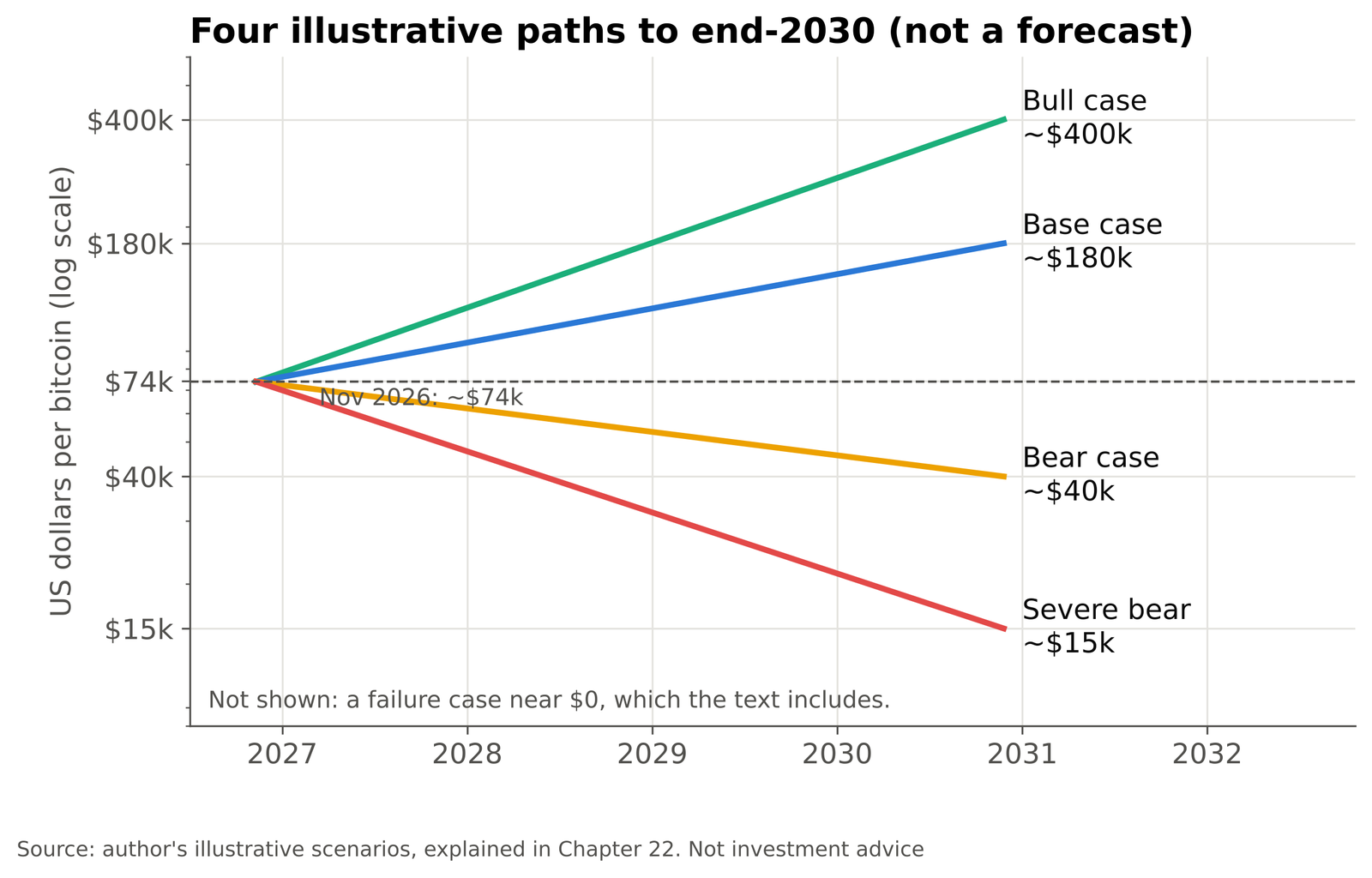
Bitcoin is highly volatile. Its price can fall by half or more, and you can lose some or all of the money you invest. Past performance and the scenarios described are not forecasts. The calculators on this site are simplified illustrations.

Facts were checked as of November 2026 and may be out of date. Before making any financial or tax decision, consult a qualified, licensed professional who can consider your personal situation.

Amazon