Bitcoin and blockchain glossary
#
- 51% attack
- An attempt by someone controlling most of the network's mining power to rewrite recent blocks or censor transactions. It can't steal coins from other people's wallets.
A
- Address
- A string, usually starting with bc1, that can receive bitcoin. Like an account number you can share.
- ASIC
- A chip built only for Bitcoin mining.
B
- BIP
- Bitcoin Improvement Proposal: a public design document for a change to Bitcoin.
- Block
- A batch of transactions added to the blockchain roughly every ten minutes.
- Blockchain
- The chain of blocks that makes up Bitcoin's public ledger. Each block carries the fingerprint of the one before it.
C
- Cold storage
- Keeping private keys on a device or medium never connected to the internet.
- Confirmation
- Inclusion of a transaction in a block. Each later block adds another confirmation.
- Correlation
- How closely two assets move together, from −1 (opposite) to +1 (in step). Bitcoin's link to stocks has been low to moderate.
- Cost basis
- What you paid for an asset, including fees. Used to work out taxable gains.
- Custodial
- Someone else, such as an exchange, holds the keys to your bitcoin.
D
- DCA
- Dollar-cost averaging: buying a fixed amount on a regular schedule, whatever the price.
- Difficulty
- How hard it is to mine a block. It adjusts every 2,016 blocks to keep blocks about ten minutes apart.
- Double spending
- Spending the same digital money twice — the problem Bitcoin solved without a bank in the middle.
- Drawdown
- A fall from a previous peak to a later low, usually shown as a percentage.
E
- ETF
- Exchange-traded fund. A spot bitcoin ETF holds real bitcoin and trades like a share.
- Expected value
- Each possible outcome multiplied by its probability, added up. Useful for comparing bets, but only as good as the odds you assume.
- Expense ratio
- The yearly fee a fund charges, as a percentage of what you hold. Spot bitcoin ETFs charge about 0.14–0.25%.
F
- Fee rate
- The fee per unit of data, in satoshis per virtual byte (sat/vB).
- Fiat money
- Government-issued money that isn't backed by a commodity like gold.
G
- Genesis block
- The first Bitcoin block, mined on 3 January 2009.
H
- Halving
- The 50% cut in new bitcoins per block every 210,000 blocks, about every four years.
- Hardware wallet
- A small device that keeps your private keys offline and signs transactions.
- Hash
- A one-way digital fingerprint of data. Bitcoin uses SHA-256.
- Hashrate
- The total computing power securing the network, in hashes per second.
- HODL
- Bitcoin slang for holding through volatility, from a 2013 forum typo.
- Hot wallet
- A wallet whose keys live on an internet-connected device such as a phone.
K
- KYC
- Know Your Customer: identity checks required by regulated exchanges.
L
- Leverage
- Borrowing to make a bigger bet. It multiplies gains and losses.
- Lightning Network
- A layer on top of Bitcoin for instant, very cheap payments through payment channels.
- Liquidation
- When a leveraged position is closed automatically because losses have used up the borrower's collateral.
M
- Market cap
- Price multiplied by the number of coins in existence.
- Mempool
- The waiting room of unconfirmed transactions.
- MiCA
- The European Union's Markets in Crypto-Assets Regulation.
- Mining
- Using specialized computers to add new blocks and earn new bitcoins plus fees.
- Multisig
- A wallet that needs several keys, such as 2 of 3, to move funds.
N
- Node
- A computer running Bitcoin software that stores the blockchain and checks every rule.
P
- Private key
- The secret number that controls your bitcoin. Never share it.
- Proof of work
- Proof that real computing effort was spent. The basis of Bitcoin's security.
- Public key
- A number derived from your private key, used to check your signatures.
R
- Rebalancing band
- The range you allow an investment to drift within before you trim it or add to it, such as 3–5%.
S
- Satoshi (sat)
- The smallest unit of bitcoin: 0.00000001 BTC.
- Seed phrase
- 12 or 24 words that back up your wallet and can restore every key in it.
- Self-custody
- Holding your own private keys, with no company in between.
- Spread
- The gap between the price you pay and the market price. Many "zero-fee" apps earn their money here.
- Stablecoin
- A token designed to hold a steady value, usually one US dollar.
- Step-up in basis
- The US rule that generally resets an inherited asset's cost basis to its value at the owner's death.
- Strategic Bitcoin Reserve
- The US government's reserve of forfeited bitcoin, created by executive order in March 2025.
T
- Taproot
- A 2021 upgrade that added Schnorr signatures and more private, flexible spending rules.
U
- UTXO
- Unspent transaction output: a separate chunk of bitcoin you can spend, like a banknote in a wallet.
V
- Volatility
- How much a price swings, usually measured as a yearly percentage. Bitcoin's has been about six times that of stocks.
W
- Wash-sale rule
- A tax rule that disallows a loss if you buy the same asset back within 30 days. It covers bitcoin ETFs; a bill would extend it to bitcoin itself.
- Whale
- A holder with enough bitcoin to move the market, commonly 1,000 BTC or more.
- Wrapped bitcoin
- A token on another blockchain that represents bitcoin held by a custodian. It adds that custodian's risk.
X
- x402
- An open standard that lets software and AI agents pay for online services automatically.
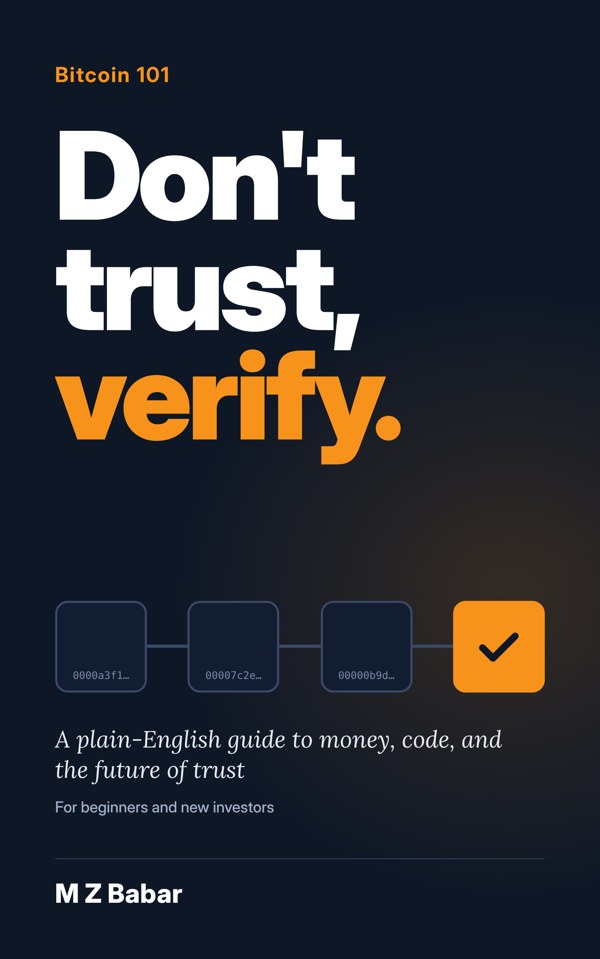
Go deeper: Don't Trust, Verify
A plain-English Bitcoin book for beginners and new investors: 27 chapters, 20 original charts, a written plan template and facts current to November 2026.
Get the bookRead chapter 1 free